Using a Deck of Cards for Divination
⏱️ 6 min read
Discovering how to use a standard deck of playing cards for divination can lead to profound insights about yourself or the future. This article explores methods for reading with playing cards at home, delving into what the symbols mean and providing a reliable theoretical framework for how this practice works.
Core Search Intent Details
Search Intent: The user has an informational search interest. They seek methods for using a standard playing card deck for divination at home, either for self-insight or for predicting future events. The user wants to know how it’s done, the meanings behind the symbols, and seeks a credible theoretical framework for why it works.
Immediate Response in the Article: The article should begin by explaining that one can divine with playing cards by using the deck as a tool to focus intention and gain access to what Vadim Zeland calls the "Space of Variants." This practice is not about chance; rather, it utilizes the cards as a bridge between the conscious and the subconscious/outer intention.
Key Meanings, Symbols & Theoretical Basis
To give the article depth and authority, the following concepts from the sources are included:
- Space of Variants (Vadim Zeland): According to the Transurfing model, the future is not fixed. It comprises an information structure containing all possible scenarios. Using a deck for divination is seen here as "scanning" sectors of this space to determine which track one is currently on.
- Outer Intention (Vadim Zeland): This is the force that realizes a specific variant in reality. The cards serve as a ritual to silence rational thinking and allow the outer intention to speak through the hands that shuffle the deck.
- Sensory Acuity (Alder/NLP): To successfully read with a deck at home, one needs to develop "Sensory Acuity." This means honing the ability to notice small details and patterns in the card placements and one’s own internal reactions.
- Framing/Reframing (Alder/NLP): Divination often operates as a form of "Content Reframing." By seeing their issues represented in the cards, one can shift perspective and discover new solutions that were previously hidden from rational thought.
- World Model (Alder/NLP): Each divination system, including Chinese divination, is a specific "Model of the World." It acts as a map of reality that helps the practitioner sort information and make decisions based on the system's internal logic.
Do you have questions or need help?
Contact us on WhatsAppPractical Guide: Step-by-Step Divination at Home
This guide combines traditional card layout techniques with NLP methods for maximum effectiveness:
- Create a Resourceful State: Before starting, put yourself in a "Resourceful State." This involves calm and focus. Minimize the influence of pendulums (external distractions or stress) so as not to disturb your intention.
- Define Your Goal (Outcome): Be clear about what you want to know. Within NLP, this is known as a well-formed "Outcome." The question should be specific and phrased positively.
- Shuffle and Choose (Sliding): As you shuffle your deck, imagine you are "sliding" through the space of variants. Stop shuffling when you feel an intuitive impulse (connect with outer intention).
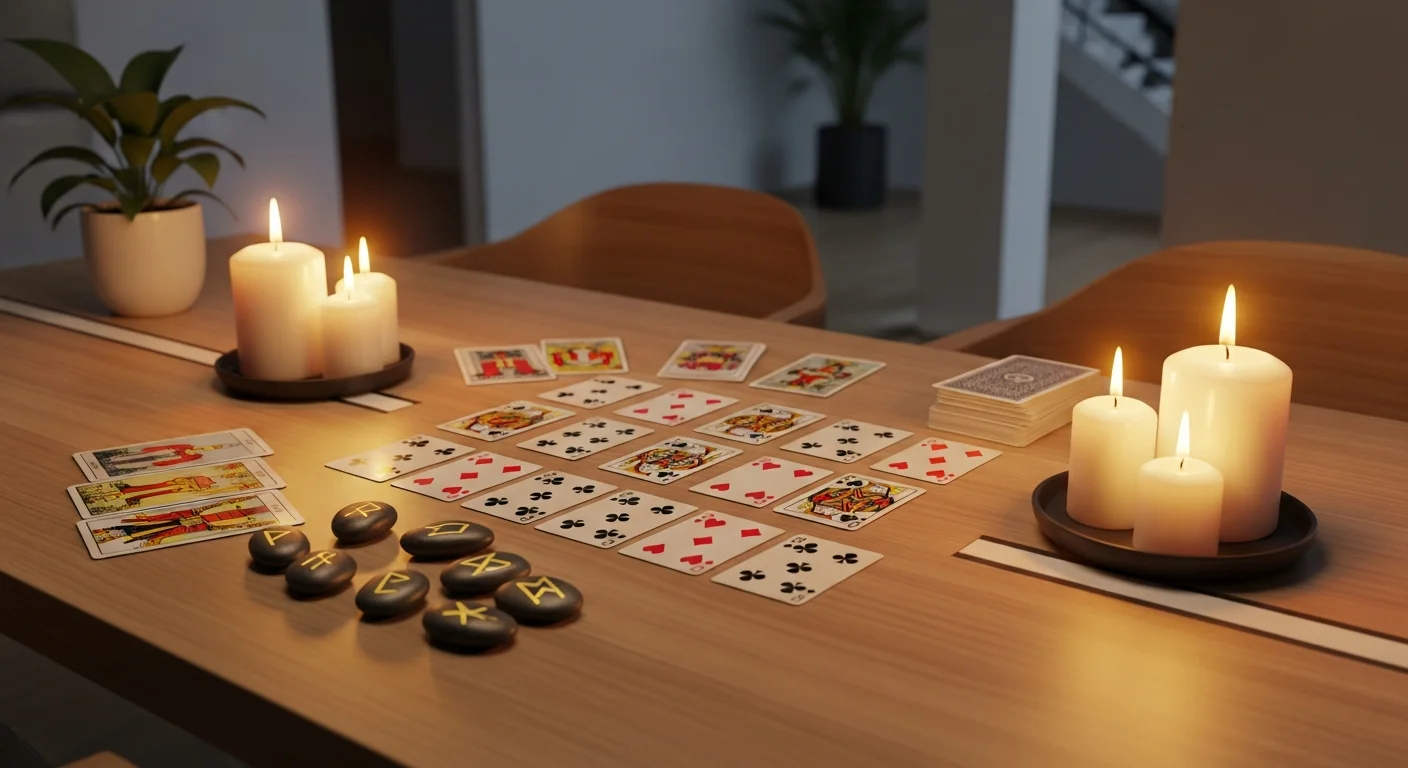
- Card Layout: Lay out the cards in a pattern. Analyze them not just based on established meanings, but also utilize your "submodalities" – notice the feelings, colors, or inner images that arise when you see specific cards.
- Analyze Sensory Cues: If you are reading for someone else, use "Sensory Acuity" to read their body language and eye movements (Eye Accessing Cues) to see how your interpretation lands with them.
Comparison or Summary Table
| Concept/Technique | Source/Author | Function in Divination |
|---|---|---|
| Space of Variants | Vadim Zeland | Explains the cards' ability to show different scenarios. |
| Ankare (Anchoring) | Harry Alder (NLP) | Using a specific card as a mental trigger for a desired state. |
| Pendulums | Vadim Zeland | Warns against allowing others' opinions to drive card interpretations. |
| World Model | Harry Alder (NLP) | Sees systems like Chinese divination as personal filters for reality. |
| The Importance of Non-Importance | Vadim Zeland | Explains that one gets the best answers when not desperate (excess energy). |
Interesting Facts / Myths
- The Myth of "Fate:": Many believe that the cards show a predetermined fate. According to Transurfing, the cards reflect only the most likely variant at the moment. You can always change the "film roll" by altering your intention.
- The Secret to Non-Importance: The most common reason divination fails is related to "Importance" (significance). If you are too fixated on a specific answer, you create excess energy that blocks the outer intention from providing a correct response.
- The Cards as Anchors: In NLP, one can use a specific successful card from a deck for divination as a physical "anchor." By carrying the card, one can recall the positive state felt during the reading.
💡 Tips: Always approach your divination sessions with an open heart and mind. Trust your intuition as the cards reveal insights that may guide you on your journey.
Frequently Asked Questions
You can ask any question that you wish to gain insight on, whether it’s related to your personal life, relationships, career, or more. Just remember to phrase your questions positively and clearly.
Yes! With practice and the right mindset, anyone can learn to use a deck for divination. It often helps to combine intuition with techniques from NLP or other methods.
Card interpretations can vary, but it often helps to connect with your feelings regarding each card, and consider how the combination of cards relates to your question.
Do you have questions or need help?
Contact us on WhatsApp